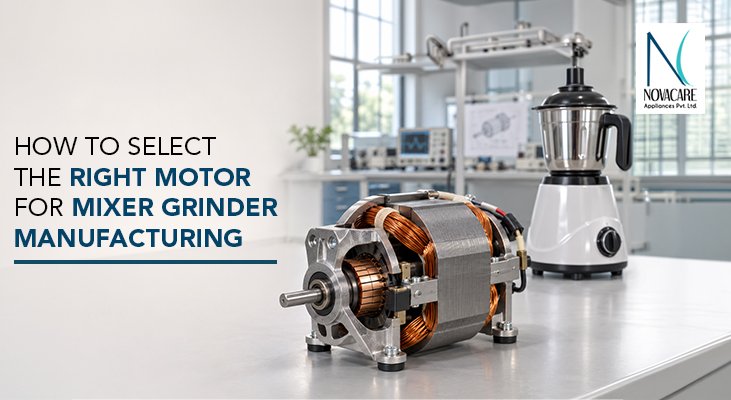
The motor is one of the most important components in a mixer grinder.
Its quality directly affects grinding performance, speed, durability, noise level, energy use, and overall product reliability. For appliance brands, selecting the right motor specification is an important part of product development.
Why Motor Selection Matters
A mixer grinder may look premium from the outside, but its actual performance depends heavily on the motor inside.
An unsuitable motor can result in:
- Low grinding efficiency
- Excessive noise
- Overheating
- Reduced product life
- Inconsistent speed
- Higher warranty complaints
The motor should match the intended usage and product positioning.
Choose the Right Power Rating
Mixer grinders are available in different wattage options depending on their intended use.
Higher wattage can support heavier grinding requirements, while lower wattage may be suitable for lighter daily tasks.
Brands should consider:
- Target customer
- Grinding requirements
- Jar capacity
- Expected usage frequency
- Product price segment
The goal should be to select the right power level rather than simply choosing the highest wattage.
Copper Winding Quality Matters
Motor winding plays an important role in performance and durability.
Brands should discuss:
- Copper winding quality
- Winding consistency
- Heat resistance
- Insulation quality
- Motor efficiency
Reliable winding can support more stable motor performance during regular use.
Consider Heat Management
Mixer grinder motors generate heat while operating.
Proper ventilation and thermal protection help prevent excessive temperature buildup.
Manufacturers may consider:
- Ventilation design
- Cooling airflow
- Thermal protection
- Motor insulation
- Overload protection
Good heat management can help improve product reliability.
Check Motor Speed and Load Performance
The motor should perform consistently when the mixer grinder is operating under actual load.
Testing may include:
- No-load speed
- Load performance
- Grinding efficiency
- Noise
- Vibration
- Temperature rise
- Continuous operation
Testing under real operating conditions helps identify performance issues before bulk production.
Match the Motor with Other Components
The motor does not work independently.
Its performance also depends on components such as:
- Coupler
- Blades
- Bearings
- Jar design
- Speed controls
- Internal wiring
- Power supply components
Poor coordination between these parts can reduce overall appliance efficiency.
Balance Performance and Manufacturing Cost
Premium motor specifications can increase product cost.
Brands should select the motor based on:
- Target selling price
- Intended usage
- Required durability
- Customer expectations
- Product positioning
An entry-level mixer grinder and a premium heavy-duty model may require different motor configurations.
Approve the Final Motor Specification
Once the product sample is approved, motor specifications should remain consistent during bulk manufacturing.
Any change in motor type, winding, supplier, or performance rating should be properly evaluated before production.
Maintaining approved specifications helps improve batch consistency.
Novacare Appliances as Your Manufacturing Partner
Novacare Appliances offers OEM, ODM, and private-label manufacturing for home and kitchen appliance brands, with support across motor and component selection, sample development, performance testing, product customisation, packaging, and scalable production.
Selecting the right internal components can help brands develop mixer grinders suited to their target market and performance requirements.
Conclusion
The motor is the core performance component of a mixer grinder.
Power rating, winding quality, heat management, load performance, and compatibility with other components should all be considered before bulk production.
Choosing the right motor specification can help improve performance, durability, and customer satisfaction.
The right motor builds better grinding performance.