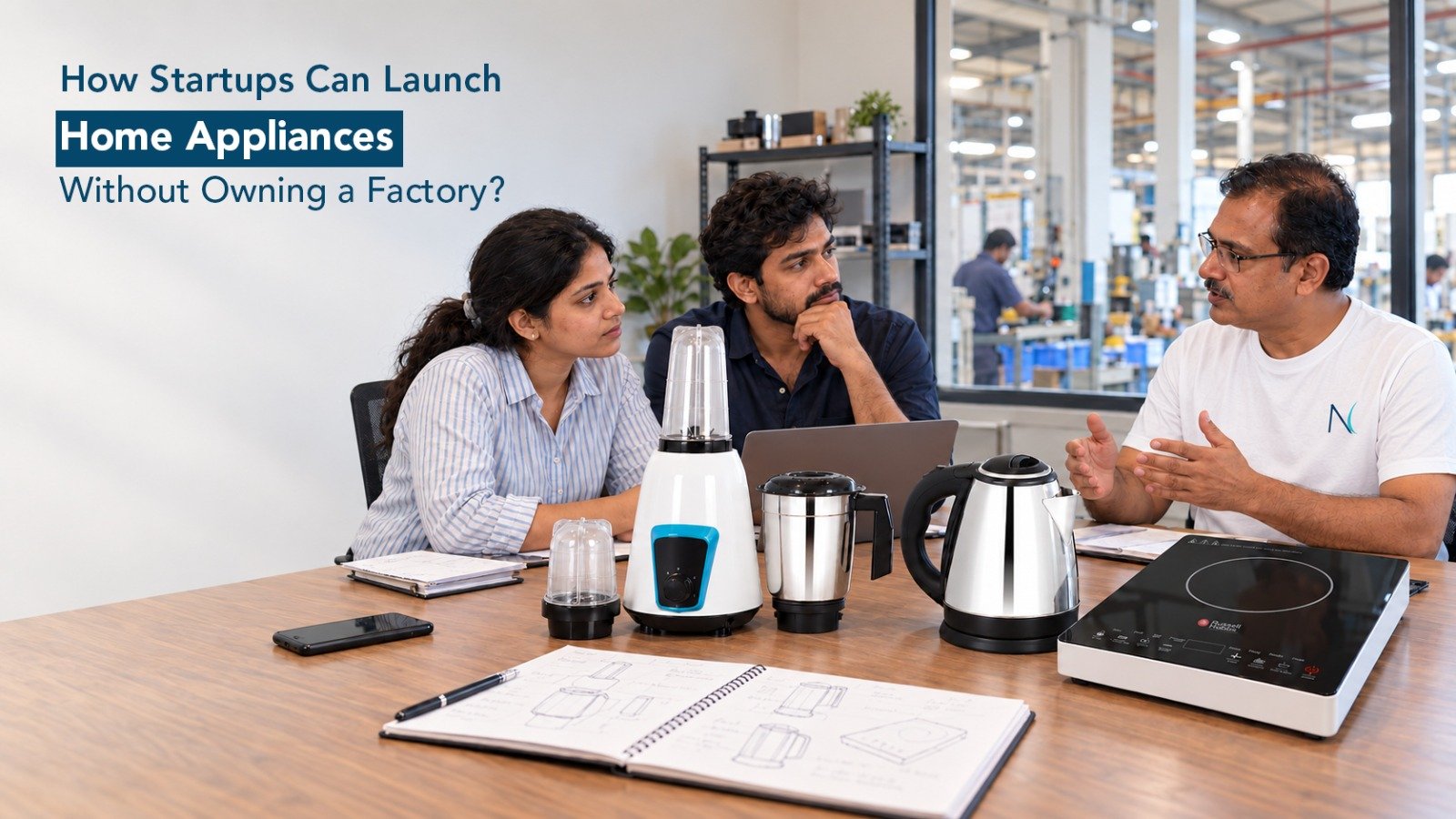
Starting a home appliance brand does not always require investing in your own manufacturing facility.
Today, startups can work with experienced OEM, ODM, and private-label manufacturers to develop and launch products under their own brand name.
This approach allows new brands to focus on product selection, branding, marketing, distribution, and customer experience while the manufacturing partner manages product development and production.
With the right planning and manufacturing partner, startups can enter the appliance market with lower infrastructure requirements and a more scalable business model.
Do You Need Your Own Factory to Start an Appliance Brand?
No. A startup can launch a home appliance range by partnering with an established appliance manufacturer.
Instead of investing in:
- Factory infrastructure
- Production machinery
- Assembly lines
- Manufacturing staff
- Testing equipment
- Raw-material sourcing
- Production management
- Quality-control systems
the brand can use the existing manufacturing capabilities of an OEM or ODM partner.
This can significantly reduce the operational complexity involved in launching a new appliance business.
What Is OEM Manufacturing?
OEM stands for Original Equipment Manufacturer.
In an OEM arrangement, a manufacturer produces appliances according to the specifications and requirements of another brand.
Depending on the project, brands may be able to customise:
- Product specifications
- Colour
- Features
- Logo placement
- Accessories
- Packaging
- Instruction manuals
- Warranty cards
OEM manufacturing can be suitable for brands that already have a clear understanding of the type of product they want to launch.
What Is ODM Manufacturing?
ODM stands for Original Design Manufacturer.
In an ODM model, the manufacturer can support both product development and manufacturing.
This can be useful for startups that have a product idea but need technical support to convert it into a manufacturable appliance.
ODM support may include:
- Product planning
- Design development
- Component selection
- Prototype or sample development
- Product customisation
- Testing
- Packaging development
- Production
For startups with limited manufacturing experience, ODM can simplify the product-development process.
How Does Private-Label Manufacturing Work?
Private-label manufacturing allows a startup to select an existing or manufacturer-developed appliance and sell it under its own brand.
The product may be customised with:
- Brand logo
- Product colour
- Packaging
- Labels
- Manuals
- Accessories
- Selected specifications
This model can help brands enter the market faster because the basic product platform may already be developed.
Private-label manufacturing can be particularly useful for startups that want to test a category before investing in extensive product development.
Start With the Right Product Category
Startups should avoid launching too many products at the beginning.
It is usually better to start with a focused product range based on:
- Target customer
- Market demand
- Selling price
- Competition
- Distribution channel
- Product margin
- After-sales requirements
- Seasonal demand
For example, a startup may begin with one or two kitchen appliances and expand the range after understanding customer response.
A focused launch also makes inventory, marketing, and quality management easier.
Define Your Product Requirements Clearly
Before approaching a manufacturer, startups should prepare a basic product brief.
The brief should include:
- Appliance category
- Target selling price
- Expected specifications
- Required features
- Product design preferences
- Colour options
- Expected order quantity
- Packaging requirements
- Target market
- Launch timeline
Clear requirements help the manufacturer recommend suitable product configurations and manufacturing options.
Understand MOQ Before Planning Your Launch
MOQ means Minimum Order Quantity.
The MOQ can vary depending on:
- Product category
- Customisation level
- Component availability
- Packaging requirements
- Mould or tooling requirements
- Production setup
- Manufacturer capacity
Startups should discuss MOQ early because it directly affects initial investment and inventory planning.
Higher levels of customisation may also require larger production quantities or additional development costs.
Always Approve a Sample Before Bulk Production
A startup should not move directly from product selection to mass production.
A final sample should first be developed and approved.
The sample should be checked for:
- Product performance
- Build quality
- Colour and finish
- Features
- Controls
- Accessories
- Branding
- Packaging
- Safety
- User experience
The approved sample should become the reference standard for bulk production.
This helps reduce misunderstandings between the brand and manufacturer.
Understand the Cost Beyond the Product Price
Startups should calculate the complete cost of launching an appliance, not just the manufacturing price.
Additional costs may include:
- Product development
- Tooling
- Custom moulds
- Packaging
- Printing
- Testing
- Certification
- Transportation
- Warehousing
- Marketing
- After-sales support
- Spare parts
Understanding the total landed and operational cost helps brands set a more realistic selling price and margin.
Plan Compliance Before Manufacturing
Depending on the appliance category, different regulatory requirements may apply.
Startups should discuss applicable requirements such as:
- BIS requirements
- BEE requirements, where applicable
- Legal Metrology declarations
- Packaging declarations
- Electrical safety requirements
- E-waste obligations
- Product labelling
- Import or export documentation
Compliance should be considered during product development rather than after production is complete.
Late compliance changes can result in additional cost and launch delays.
Packaging Is Part of Product Development
Packaging is not only about appearance.
For appliances, packaging also needs to protect the product during:
- Factory handling
- Warehousing
- Transportation
- Distributor movement
- E-commerce delivery
Startups should consider:
- Inner protection
- Outer carton strength
- Product positioning
- Accessories placement
- Labels
- Instruction manual
- Warranty information
- Brand communication