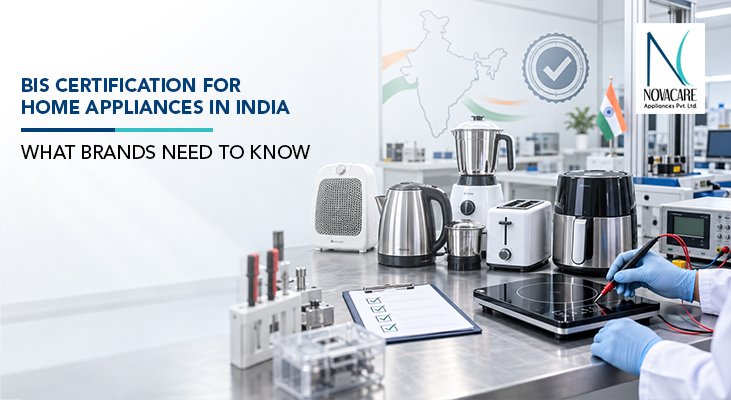
For brands looking to manufacture or sell home appliances in India, ensuring product compliance is a crucial part of the process.
Depending on the appliance category, certain products may need to meet applicable Bureau of Indian Standards requirements before they can be legally manufactured, imported, or sold in the Indian market.
Understanding BIS requirements early can help brands avoid production delays, compliance issues, product recalls, and unnecessary costs.
What Is BIS Certification?
BIS, or the Bureau of Indian Standards, is India’s national standards authority.
BIS develops and implements standards related to product quality, safety, performance, and reliability.
For certain categories of electrical and electronic products, compliance with applicable Indian Standards may be mandatory under relevant Quality Control Orders or certification schemes.
For appliance brands, BIS compliance can help ensure that products meet required safety and quality benchmarks before entering the market.
Do All Home Appliances Require BIS Certification?
Not every home appliance follows the same certification requirement.
The applicable compliance process can depend on:
- Product category
- Electrical specifications
- Intended usage
- Applicable Indian Standard
- Government notifications
- Quality Control Orders
- Whether the product is manufactured domestically or imported into India.
Brands should identify the exact regulatory requirement for their product before finalising production.
A requirement applicable to one appliance category may not necessarily apply to another.
Why Should BIS Requirements Be Verified Before Starting Production?
Compliance should ideally be discussed during the product-development stage rather than after bulk production has started.
Early planning helps brands avoid situations where changes are required in:
- Internal components
- Electrical design
- Plug and power cord
- Product construction
- Labels
- Packaging
- Instruction manuals
- Safety features
Making these changes after production has already begun can increase cost and delay the product launch.
What Product Details May Be Evaluated?
Depending on the applicable standard and appliance category, product evaluation may cover different safety and performance parameters.
These may include:
- Electrical safety
- Insulation
- Earthing
- Temperature rise
- Leakage current
- Power consumption
- Mechanical construction
- Internal wiring
- Heating components
- Motor performance
- Protection against electrical hazards
The required tests vary depending on the product category and the applicable Indian Standard.
Why Component Selection Matters for Compliance
Internal components play an important role in appliance safety and reliability.
Brands should discuss component specifications with their manufacturer before sample development.
Important areas may include:
- Motor
- Heating element
- PCB
- Thermostat
- Thermal fuse
- Switches
- Internal wiring
- Power cord
- Plug
- Insulation materials
- Plastic and metal components
Changing critical components after testing or approval may affect product compliance and may require further evaluation.
What Documents May Be Required?
The documents required for BIS compliance may vary depending on the product category and certification route. Brands and manufacturers may need to provide information such as:
- Product specifications
- Model details
- Technical drawings
- Component details
- Manufacturing information
- Test reports
- Factory information
- Product labels
- User manuals
- Brand or trademark information
Proper documentation helps make the certification and compliance process more organised.
What Is the Manufacturer’s Role?
The manufacturer plays an important role in maintaining product consistency.
Brands should ask whether the manufacturer understands the applicable standards for the appliance category and whether the product can be developed accordingly.
Manufacturing support may include:
- Component planning
- Product design coordination
- Sample development
- Testing coordination
- Technical documentation
- Product labelling support
- Production-quality control
- Batch consistency
Clear coordination between the brand, manufacturer, testing laboratory, and compliance professionals can reduce unnecessary delays.
Can One Certification Cover Multiple Models?
This depends on the applicable certification scheme, product standard, product design, and differences between individual models.
Products with changes in areas such as:
- Wattage
- Electrical construction
- Heating system
- Motor
- PCB
- Dimensions
- Safety components
- Product configuration
may need to be evaluated separately or included according to the applicable certification rules.
Brands should confirm model coverage before creating a large product range.
What Happens If a Product Is Modified After BIS Approval?
Product changes should be managed carefully after certification or testing.
Changing important components or specifications may affect the approved product configuration.
Brands should maintain proper records when changing:
- Motors
- Heating elements
- Electrical components
- Safety devices
- PCB design
- Power ratings
- Internal wiring
- Construction materials
Major product changes should be reviewed for compliance before moving into bulk production.
BIS Certification and Imported Appliances
Brands importing appliances into India should also check whether their product category falls under mandatory BIS requirements.
Compliance planning should be completed before importing commercial quantities.
Importers may need to coordinate with:
- Overseas manufacturers
- Testing laboratories
- Compliance consultants
- Indian regulatory authorities
- Packaging and labelling teams
Importing products without understanding applicable requirements can result in delays or additional compliance costs.
BIS Is Only One Part of Appliance Compliance
Depending on the product category, brands may also need to comply with additional regulatory requirements.
These can include:
- BEE requirements, where applicable
- Legal Metrology declarations
- E-waste regulations
- Packaging requirements
- Electrical safety requirements
- Product labelling requirements
- Import documentation
- Other category-specific regulations
Compliance should therefore be treated as part of the complete product-development process rather than as a single final-stage activity.
Questions Brands Should Ask Their Manufacturer
Before starting production, brands can ask:
- Which Indian Standard applies to this appliance?
- Is BIS certification mandatory for this category?
- Has the product been designed around the applicable safety requirements?
- Which components are critical for compliance?
- Can the manufacturer support sample development?
- What documents will be required?
- Can packaging and labelling requirements be supported?
- How will approved specifications remain consistent during production?
- What happens if a component needs to be changed?
These questions help establish clear responsibilities before bulk manufacturing begins.
Novacare Appliances as Your Manufacturing Partner
Novacare Appliances provides OEM, ODM, and private-label manufacturing solutions for home and kitchen appliance brands.
Our product-development process can include component planning, customisation, sample development, quality testing, packaging coordination, and scalable bulk production.
We work with brands to define product requirements early and help align product development with applicable quality, safety, and compliance considerations before mass production.
Conclusion
BIS compliance is an important consideration for appliance brands entering the Indian market.
The exact certification requirement depends on the product category, applicable Indian Standard, and current regulatory framework.