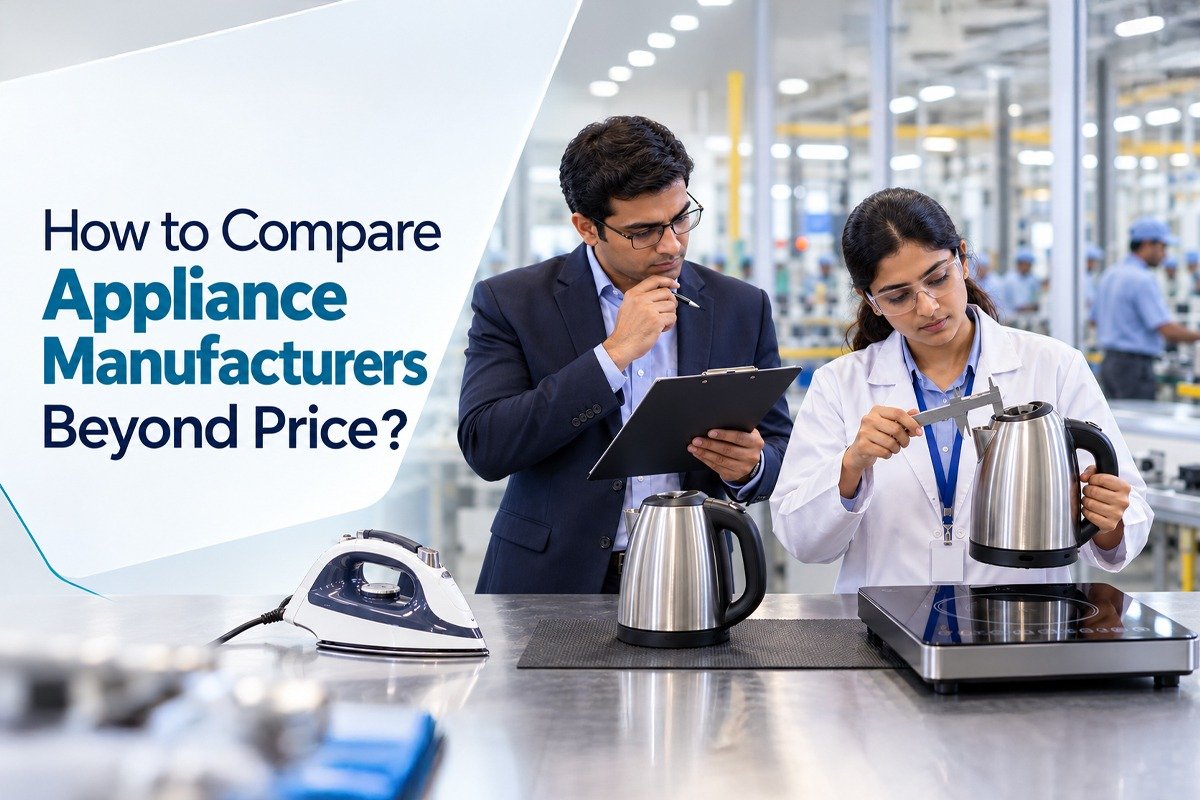
Price is an important factor when choosing an appliance manufacturer, but it should not be the only factor.
Two manufacturers may offer similar-looking products at different prices, but the difference can come from component quality, testing standards, production systems, customisation options, compliance support, packaging quality, and after-sales capabilities.
A low quotation may look attractive initially, but it could result in quality concerns, delayed deliveries, returns and higher costs later.
A better approach is to compare manufacturers based on overall value, consistency, and long-term reliability.
Why Price Alone Is Not Enough
A cheaper manufacturing quote may lead to higher costs over time.
A cheaper quotation may involve compromises in:
- Internal components
- Material quality
- Testing
- Packaging
- Quality inspection
- Production consistency
- Spare-parts availability
- Technical support
If these areas are not managed properly, the brand may face higher costs through product failures, customer complaints, replacements, warranty claims, and returns.
Brands should therefore evaluate what is included behind the quoted price.
Compare the Components Being Used
The components inside an appliance play a key role in its performance and durability.
Before comparing quotations, brands should understand whether the manufacturers are offering the same component specifications.
Depending on the appliance, important components may include:
- Motor
- Heating element
- PCB
- Thermostat
- Thermal fuse
- Switches
- Power cord
- Internal wiring
- Bearings
- Couplers
- Insulation materials
Two appliances may look alike but differ in the quality and cost of the components inside.
Component specifications should therefore be compared carefully.
Check Build and Material Quality
The materials used on an appliance’s exterior influence how it looks, how well it lasts and how customers perceive it.
Brands should compare areas such as:
- Plastic quality
- Metal thickness
- Surface finish
- Glass quality
- Handle strength
- Knob quality
- Product stability
- Fit and finish
- Assembly accuracy
An appliance may look good in photographs but feel different when examined in person.
This is why sample evaluation is important before selecting a manufacturing partner.
Understand the Manufacturer’s Testing Process
A reliable manufacturer should have a structured quality-testing process.
Brands should ask what checks are performed during production.
These may include:
- Incoming component inspection
- Assembly-stage inspection
- Electrical safety testing
- Performance testing
- Motor-load testing
- Heating tests
- Visual inspection
- Final quality checks
- Pre-dispatch inspection
A slightly higher manufacturing cost may provide better value if the manufacturer follows stronger quality-control procedures.
Evaluate Production Capacity
Brands should choose a manufacturer capable of fulfilling their current orders and supporting larger volumes as demand grows.
Important questions include:
- What is the monthly production capacity?
- How many production lines are available?
- Can production increase during peak demand?
- How are large orders scheduled?
- How are multiple product categories managed?
- What happens if demand increases suddenly?
A manufacturer that can fulfil a small trial order may not have the capacity to meet demand as your business grows. Evaluate the manufacturer’s production capacity with your future growth in mind.
Compare Customisation Capabilities
The customisation available for your appliance will depend on what the manufacturer can provide.
Brands should compare whether they can modify:
- Product colour
- Logo placement
- Control panel
- Features
- Power specifications
- Accessories
- Packaging
- Instruction manuals
- Warranty cards
Some manufacturers may only provide basic branding, while others may support deeper product development.
Brands should select a manufacturer that offers the level of customisation needed for their products and business goals.
Check Product Development Support
When developing a new or customised appliance, brands should look for a manufacturer with the expertise to support product development.
A manufacturing partner may assist with:
- Product planning
- Component selection
- Technical feasibility
- Sample development
- Prototyping
- Tooling
- Testing
- Product improvement
- Cost optimisation
Such support can help startups and established brands navigate the launch of a new appliance category.
Ask About Compliance Support
Compliance requirements vary across appliance categories.
Brands should confirm that the manufacturer is familiar with the applicable requirements for:
- BIS
- BEE, where applicable
- Legal Metrology
- Electrical safety
- Product labelling
- Packaging declarations
- E-waste requirements
- Export documentation
Compliance knowledge can help prevent product-development decisions that may create problems later.
Brands should also consult qualified compliance professionals to confirm which requirements apply to their products.
Compare MOQ and Flexibility
MOQ, or Minimum Order Quantity, can have a major impact on inventory and cash flow.
When comparing manufacturers, brands should understand:
- MOQ per model
- MOQ per colour
- Packaging MOQ
- Customisation MOQ
- Tooling requirements
- Component MOQ
For a growing brand, a flexible MOQ with a slightly higher unit price may be more manageable than a lower price that requires a much larger order.
The complete commercial structure should be evaluated.
Review Lead Times Carefully
Reliable production planning supports timely launches, steady inventory and on-time deliveries to distributors.
Brands should compare:
- Sample-development time
- Tooling time
- Packaging-development time
- Raw-material procurement
- Production lead time
- Inspection time
- Dispatch schedule
Manufacturers should provide timelines they can realistically meet. Consistent delivery helps brands plan with confidence and meet their own commitments.
Check Packaging Support
Packaging plays an important role in product protection and presentation.
Brands should compare whether the manufacturer can support:
- Inner protective packaging
- Outer cartons
- Printed boxes
- Product labels
- Barcodes
- Manuals
- Warranty cards
- Accessory placement
- Transit protection
Poor packaging can lead to transit damage even when the appliance itself is manufactured correctly.
Packaging quality should therefore be included when comparing total manufacturing value.
Understand How Quality Consistency Is Maintained
A high-quality sample alone does not guarantee the same quality across every unit produced.
Brands should ask how the manufacturer controls consistency across production batches.
Important processes may include:
- Approved sample control
- Component specifications
- Production checklists
- Batch inspection
- Traceability
- Final quality records
- Defect reporting