Introduction
Mixer grinders are among the most widely used kitchen appliances in India. From grinding spices and preparing chutneys to blending shakes and making batter, they support everyday cooking needs.
With growing demand for convenient kitchen appliances, mixer grinders offer a strong opportunity for retailers, distributors, e-commerce sellers and emerging appliance brands.
However, launching a successful mixer grinder requires more than selecting an attractive design. Motor performance, jar quality, blade construction, safety features, testing and packaging all play an important role.
Why the Mixer Grinder Category Is Growing
Indian consumers are looking for appliances that make cooking faster and easier. Mixer grinder demand is supported by:
- Increasing adoption of electric kitchen appliances
- Growth of online appliance shopping
- Demand for compact and multifunctional products
- Expansion of private-label appliance brands
- Consumer focus on performance, durability and design
This allows brands to introduce mixer grinders across value, standard and premium market segments.
Mixer Grinder Manufacturing Process
1. Product Planning
The manufacturing process starts by identifying the target audience, pricing segment, and desired market position.
Brands must determine:
- Motor wattage
- Number and capacity of jars
- Product design
- Speed settings
- Safety features
- Colour combination
- Packaging requirements
A budget model may focus on basic everyday performance, while a premium mixer grinder may offer stronger motor capability, improved jar quality and a more refined finish.
2. Component Selection
The performance of a mixer grinder depends on the quality of its components.
Important components include:
- Motor
- Motor winding
- Stainless-steel jars
- Grinding blades
- Coupler
- Speed-control switch
- Overload protector
- Housing and base
- Power cord
These components must work together properly to deliver consistent grinding with controlled noise, vibration and heat generation.
3. Assembly
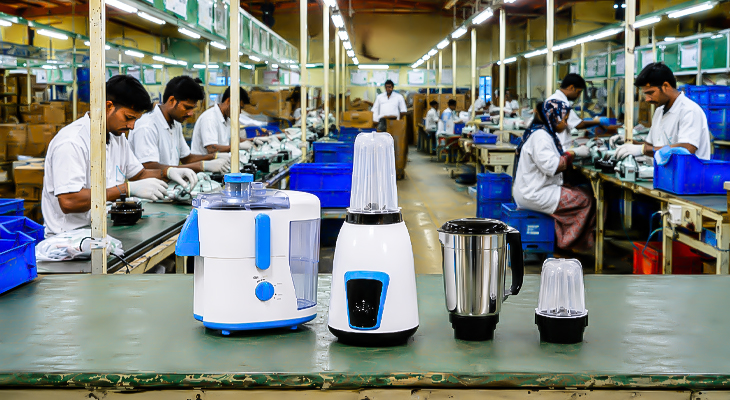
During assembly, the motor, wiring, control system, coupler and safety components are fitted inside the product housing.
The jars, blades, handles and lids are assembled separately before being matched with the main unit.
Precise assembly is important, as improper alignment may lead to excessive vibration, noise, leakage, or lower performance.
Choosing the Right Motor and Jars
Motor wattage is a key factor, but overall performance also depends on motor quality, torque, ventilation, blade design, and intended usage.
Brands should also evaluate:
- Motor torque
- Winding quality
- Heat management
- Ventilation
- Blade design
- Intended usage
Jar configuration also affects the customer experience. Common options include:
- Liquidising jar
- Dry grinding jar
- Chutney jar
- Juicer jar
Jar thickness, handle strength, lid fitting, blade alignment and leakage resistance should be checked before production approval.
Quality Testing
Testing helps ensure that the mixer grinder performs safely and consistently.
Common tests include:
Electrical Safety Testing
Checks insulation, wiring, electrical leakage and voltage handling.
No-Load Testing
Evaluates motor sound, rotation, speed control and vibration without ingredients.
Load Testing
Evaluates grinding efficiency, motor stability, and heat levels during real operating conditions.
Jar Leakage Testing
Check the lid, gasket and blade-shaft assembly for liquid leakage.
Endurance Testing
Assesses motor, switch, coupler and component performance over repeated operating cycles.
Packaging Testing
Ensures the mixer grinder and jars remain protected during storage and transportation.
OEM, ODM and Private-Label Manufacturing
Appliance brands can launch mixer grinders through different manufacturing models.
OEM Manufacturing
The manufacturer produces the mixer grinder according to the brand’s approved specifications, colours, features and packaging.
ODM Manufacturing
The manufacturer supports product development, design selection, component planning, prototyping and testing.
Private-Label Manufacturing
A standard or customised product is produced and sold under the buyer’s own brand name.
Private-label customisation may include:
- Logo placement
- Product colour
- Jar configuration
- Model name
- User manual
- Warranty card
- Retail packaging
- Barcode and outer carton
This allows appliance businesses to enter the market without setting up their own manufacturing facility.
How to Choose a Mixer Grinder Manufacturer
Before selecting a manufacturing partner, appliance brands should evaluate:
- Manufacturing capacity
- Component quality
- Testing infrastructure
- Product customisation options
- Compliance knowledge
- Packaging support
- Production consistency
- Communication and delivery timelines
Brands should also test samples under realistic kitchen conditions before approving bulk production.
Conclusion
Mixer grinder manufacturing involves product planning, component selection, assembly, testing, custom branding and protective packaging.
A successful product should provide:
- Reliable motor performance
- Suitable jar combinations
- Safe and stable operation
- Consistent grinding results
- Durable construction
- Market-ready packaging
At Novacare Appliances, we support brands with OEM, ODM and private-label mixer grinder manufacturing solutions. From product configuration and branding to quality testing and packaging, we help appliance businesses build mixer grinder ranges suited to their target market.