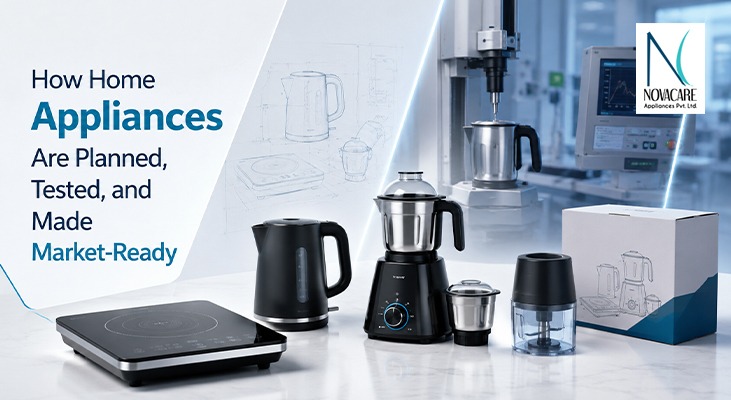
In today’s competitive appliance market, a product cannot succeed only because it looks good. It needs to perform well, meet safety expectations, suit the needs of modern consumers and be reliable enough for daily use.
Behind every induction cooktop, infrared cooktop, mixer grinder, kettle, heater or kitchen appliance, there is a detailed manufacturing journey. From the first idea to the finished packed product, each step plays an important role.
At Novacare Appliances, this journey is not just about making appliances. It is about developing market-ready products that brands can confidently offer to their customers.
1. Understanding the Product Requirement
Every successful appliance starts with a well-defined product requirement. Before manufacturing begins, it is important to understand the product’s purpose, target users, and intended market. Every successful appliance begins with a clear requirement.
Before manufacturing starts, the first step is to understand what the product is expected to do, who will use it and where it will be sold. A home appliance designed for everyday Indian kitchens needs to be practical, durable, safe and easy to operate. For brands, this stage is very important because it defines the complete product direction.
The product specifications may cover size, wattage, features, materials, design, control panel layout, safety features, packaging style, and price range.
For example, an induction cooktop may need touch controls, preset cooking modes, surge protection, a ceramic plate and a compact design. A heater may require quick heating, easy portability, protective safety grills, and energy-efficient performance. Proper product planning reduces confusion during production and helps ensure the final appliance meets market expectations.
2. Product Design and Development
Once the requirement is clear, the product moves into the design and development stage. This includes deciding the outer structure, internal layout, user interface, component placement and overall product appearance. Design is not only about looks. It also affects usability, safety, assembly, performance and long-term reliability. A good appliance design should be:
- Easy to use
- Safe for daily operation
- Suitable for mass production
- Attractive for retail display
- Strong enough for regular handling
- Comfortable for the end customer
For OEM and ODM appliance manufacturing, this stage becomes even more valuable. Brands may want a ready design, a customised product or a completely new appliance concept. A manufacturing partner helps turn these ideas into a practical product format.
3. Component Selection and Sourcing
The quality of any appliance depends heavily on the components used inside it. Motors, heating elements, PCBs, wires, switches, sensors, plates, panels, plugs and body materials all affect performance. Even if two appliances look similar from the outside, their internal components can create a major difference in durability, heating efficiency, safety and user experience. This is why component selection is a critical stage in home appliance manufacturing.
Reliable sourcing helps maintain product consistency. It also ensures that the appliance performs according to the expected standards and supports long-term brand trust.
For private label appliance brands, this step is especially important because the end customer may not see the internal components, but they will definitely experience the result through performance and reliability.
4. Prototype and Sample Development
Before full production begins, a prototype or sample is created. This sample helps assess whether the product’s design, features, components, and performance are working as expected. It allows the brand and manufacturer to review the appliance before moving into bulk production. During this stage, improvements can be made in product design, button placement, body finishing, heating performance, packaging size or user convenience.
Prototype development reduces production risk. It helps identify possible issues early and gives the brand more confidence before final approval.
For OEM and ODM manufacturing, sample development is one of the most important steps because it bridges the gap between an idea and an actual market-ready product.
5. Testing and Quality Checks
An appliance is only market-ready when it passes proper testing. Testing helps confirm that the product is safe, performs properly, and remains reliable for everyday use. Depending on the appliance category, quality checks may include heating tests, power tests, load tests, switch tests, safety checks, wire inspection, body fitting checks, packaging checks and performance evaluation.
For products like induction cooktops and infrared cooktops, testing may include temperature performance, control panel response, ceramic plate quality, heating consistency and safety features.
For kitchen appliances like mixers, kettles, toasters and rice cookers, testing may focus on motor performance, heating efficiency, body strength, electrical safety and user convenience. Quality control should not be treated as only the final stage; it must be integrated throughout the entire manufacturing process. Regular inspection at different stages helps maintain consistency across every batch.
6. Production and Assembly
After the design, components and samples are approved, the product moves into production. This is where different parts come together to form the final appliance. Plastic parts, metal parts, electronic components, heating systems, control panels and accessories are assembled according to the product specifications.
A well-managed production process helps maintain speed, accuracy and consistency. This also reduces product defects and improves the final look, feel, and finish. For brands, manufacturing consistency is very important. Customers expect the brand to deliver the same level of quality every time they purchase a product.
A strong production system helps deliver that consistency.
7. Packaging and Brand Presentation
Packaging plays a major role in making an appliance market-ready. It protects the product during transport, improves retail appeal and communicates brand value to the customer. For private label and OEM appliance brands, packaging is also an important part of brand identity. A good appliance package should include:
- Clear product name
- Key features
- Safety information
- Usage details
- Branding elements
- Strong protective structure
- Professional visual appeal
- Packaging is not only about design. It must also be practical for storage, handling, shipping and display.
- When the product reaches a retail shelf, dealer counter or customer’s home, packaging becomes the first physical impression of the brand.
8. Final Inspection and Dispatch
Before dispatch, the finished appliances go through final inspection. This step checks product finishing, accessories, packaging, labels, quantity and overall readiness. The goal is to make sure that the product leaving the facility is aligned with the approved standards.
Final inspection helps reduce complaints, improve customer satisfaction and protect the brand’s reputation. Once approved, the appliances are packed and dispatched for distribution, retail, dealer networks, e-commerce or private label supply.
Why the Right Manufacturing Partner Matters
For a brand, launching a home appliance requires more than just selecting a product from a catalogue. It requires planning, technical understanding, production capability, quality control and reliable execution. This is where an experienced OEM and ODM appliance manufacturer becomes important. The right manufacturing partner helps brands with:
- Product development
- Design customization
- Component selection
- Bulk production
- Quality testing
- Private label solutions
- Packaging support
- Timely dispatch
For growing appliance brands, this allows them to focus on sales, marketing, distribution and customer relationships while the manufacturing process is handled by experts.
Novacare Appliances: Manufacturing Solutions for Modern Appliance Brands
Novacare Appliances supports brands with OEM, ODM and private label manufacturing solutions for home and kitchen appliances.
From induction cooktops and infrared cooktops to heaters, fans, kettles, mixer grinders and other appliances, the focus remains on practical design, reliable performance and consistent production quality. Every product journey requires attention to detail. From concept to countertop, each stage contributes to how the customer finally experiences the appliance.
A market-ready appliance is not created by chance. It is built through planning, testing, manufacturing discipline and quality-focused execution.
Conclusion
The journey of a home appliance starts long before it reaches the customer’s kitchen. It begins with an idea, moves through design and development, passes through component selection, testing, production, packaging and final inspection.
Every step shapes the quality, performance and reliability of the product. For brands looking to enter or expand in the home appliance market, choosing the right manufacturing partner can make all the difference.
At Novacare Appliances, the goal is to help brands bring appliances to market with confidence products that are thoughtfully developed, carefully manufactured and ready for modern consumers. For OEM, ODM and private label appliance manufacturing solutions, connect with Novacare Appliances today.